PHP is all set to rock 2024 as it did in 2022 and years prior to it. In case you didn’t know, PHP is one of the best programming languages to get a job in the present scenario.
However, having coding prowess is never enough in the world of programming. You need to keep getting better and learning new things to refine your craft. For this very reason, here we are with our pick of the best 10 PHP books that every PHP web developer must read in 2024:
Best PHP Books for Beginners & Advanced Programmers
1. The Joy of PHP Programming: A Beginner’s Guide to Programming Interactive Web Applications with PHP and MySQL

Author – Alan Forbes
Latest Edition – Fifth Edition
Publisher – Plum Island
Publishing LLC Like The Joy of PHP Programming: A Beginner’s Guide kicks off with basic HTML, newbies can get started easily. The book then escalates step by step into explaining how PHP works. It transforms a PHP newcomer into a professional dynamic website developer.
The reader starts with the easy stuff like how to create and run basic PHP scripts then move towards the concept of modifying web pages. At the later stage, the reader gets to put everything learned to test via a series of cohesive and fun exercises.
Important topics covered by The Joy of PHP Programming include installing and configuring PHP, basic PHP syntax, control structures, and using PHP and MySQL together. The PHP book also covers form creation, working with images, PHP tips, and security considerations.
2. PHP & MySQL Novice to Ninja

Author – Tom Butler & Kevin Yank
Latest Edition – Sixth Edition
Publisher – SitePoint
Throughout its 450+ pages, PHP & MySQL Novice to Ninja gives essential knowledge into PHP as well as MySQL. It does so in a fairly easy-to-read manner. The content is great, obviously, because if it wasn’t then the book shouldn’t have made to this list.
Though primarily a book about PHP, MySQL is analyzed to a greater degree in the PHP & MySQL Novice to Ninja book. However, that doesn’t mean that PHP is left incomplete.
PHP &MySQL Novice to Ninja is well written, engaging and more than satisfactorily covers basics of PHP as well as MySQL. Hence, it makes up for an excellent PHP book for newcomers.
Structured PHP programming, publishing MySQL data on the web, content formatting, and content management system are covered by the PHP & MySQL Novice to Ninja. Additionally, it also takes on relational database design, advanced SQL queries, and access control.
3. Head First PHP & MySQL
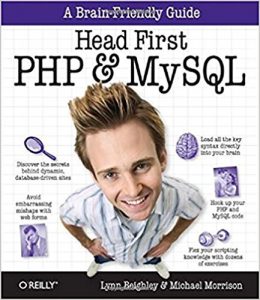
Author – Lynn Beighley & Michael Morrison
Latest Edition – First Edition
Publisher – O’Reilly
If you are already aware of the Head First book series, then you will instantly recognize Head First PHP & MySQL as one of the foremost PHP guides for beginners. The 812 pages long book is meant to be an ultimate guide for learning to build dynamic and database-driven websites.
Throughout Head First PHP & MySQL, the reader gets delighted by means of fascinating real-world examples for learning how to harness the power of the popular server-side programming language and its beloved counterpart RDBMS i.e. MySQL.
The visually-rich format formula of the Head First series works for Head First PHP & MySQL equally well as with other books in the series. In addition to the quality content, the PHP book is full of mentally-challenging exercises and quizzes.
Head First PHP & MySQL explains the creation of MySQL database tables, transforming HTML pages into dynamic websites, creating images on the fly, and making use of cookies and sessions to get visitor information and use the same for personalizing the website for users.
Not only the book covers the basic and fundamental concepts of PHP and MySQL, but Head First PHP & MySQL also takes a deep-dive into advanced topics to the likes of content management, database queries, file I/O operations, and form validation.
4. PHP: A Beginner’s Guide

Author – Vikram Vaswani
Latest Edition – First Edition
Publisher – McGraw-Hill Education
PHP: A Beginner’s Guide is a 478-page long book detailing on how to write basic PHP programs and then enhance the same with the use of advanced features, including MySQL database integration, third-party extensions, and XML input.
The PHP: A Beginner’s Guide book not only allows newbies to get started with PHP development but also develop intermediate-level adequacy in them. The book covers software installation, syntax, data structures, inbuilt functions, flow control routines, and best practices.
Other important topics covered by PHP: A Beginner’s Guide include handling errors, using classes, operators and variables, working with arrays, working with data from external sources, and securing and extending PHP. The book has something for the web developers of all skill levels.
Recommended Book
PHP for Beginners - Become a PHP Master - CMS Project
5. PHP In Action: Objects, Design, Agility

Author – Daginn Reiersol, Chris Shiflett, and Marcus Baker
Latest Edition – 1st Edition
Publisher – Manning Publications
PHP in Action is one of the leading books for advancing in PHP. Ever since its first release back in 2007, the book has helped hundreds of thousands of web developers looking to reap in the benefits of PHP.
The book excels in demonstrating the application of PHP techniques and principles for solving some of the most common challenges faced in web programming, including input validation, form handling, object persistence, and web presentation.
If you’re someone with a good understanding of Java, then you will greatly benefit from the book. This is because the author draws frequent Java references when talking about concepts pertaining to PHP.
To make things even better for the buyers, each print version of the PHP in Action comes with free ePub, Kindle, and PDF versions of the same. So, they can continue scanning through the book even when away from the paperback version.
6. Murach’s PHP and MySQL

Author – Joel Murach & Ray Harris
Latest Edition – Third Edition
Publisher – Mike Murach & Associates Inc.
Penned by Joel Murach and Ray Harris, Murach's PHP and MySQL is yet another fitting book for learning and advancing in PHP. Thanks to its self-paced approach, it is also suitable for newcomers. This 872-page book is for anyone who wishes to build and maintain websites using PHP and MySQL.
Those with some experience with PHP or programming, in general, will be able to quickly sift through the topics covered by Murach's PHP and MySQL. The book starts quickly with PHP and MySQL basics and then builds advanced skills on top of that.
In addition to presenting the key information required for understanding PHP programming, Murach's PHP and MySQL allows the readers to gain mastery over PHP programming and MySQL deployment. It also covers advanced skills suitable for building dynamic websites.
7. Learning PHP, MySQL, JavaScript, & CSS: A Step-by-Step Guide to Creating Dynamic Websites

Author – Robin Nixon
Latest Edition – Second Edition
Publisher – O’Reilly
Learning PHP, MySQL, JavaScript, and CSS educates readers about building interactive and data-driven websites. The book is one of the best-sellers for learning web development. The second edition of the book is even better thanks to following reader reviews gained on the first edition.
In order to ensure that the reader retains most of the learning imparted, each chapter follows a section with review questions. Furthermore, there is a sample social networking platform covered by the book.
Creating compelling and dynamic web pages, manipulating CSS properties from JS, and upload and manipulate files and images are also covered by this book.
8. Programming PHP: Creating Dynamic Web Pages
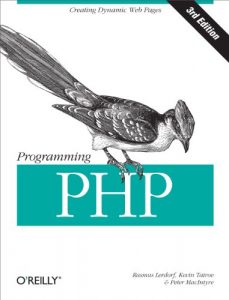 Author – Kevin Tatroe, Peter MacIntyre & Rasmus Lerdorf Foreword by Michael Bourque
Latest Edition – Third Edition
Publisher – O’Reilly
Everything that a web developer need to know for creating efficacious web applications is there in the Programming PHP book. In addition to syntax and programming techniques, the PHP book is full of examples illustrating correct usage and common idioms.
Programming PHP starts with an overview of the possibility of PHP programs and then moves on to cover the fundamentals of the web scripting language, which includes arrays, functions, objects, and strings.
In addition to detailing how to apply common web application techniques, the book also covers the concept of generating dynamic content. With Programming PHP one can also learn about the programming language’s interaction with relational databases.
Other noteworthy topics covered throughout the 550+ page run of the Programming PHP book includes error handling, performance tuning, secure scripts, and other advanced topics.
9. PHP and MySQL Web Development
 Author – Laura Thompson and Luke Welling
Latest Edition – Fifth Edition
Publisher – Addison Wesley
With a total of 1008 pages, PHP and MySQL Web Development is one of the most detailed books about PHP programming. The book offers an effectual understanding of producing interactive and intuitive web applications.
PHP and MySQL Web Development talks about the basics of the PHP programming language and how to set up a MySQL database. The book also demonstrates the interaction between the server-side scripting language and the database.
Authenticating users, generating PDF documents dynamically, and sending and managing emails are some of the common tasks pertaining to PHP. The PHP and MySQL Web Development book explains these with easy-to-understand examples.
Advanced PHP techniques, security, error and exception handling, and using PHP and MySQL for large projects are some of the main topics covered in the book. Other topics covered by PHP and MySQL Web Development include using arrays, debugging, and reusing code.
10. PHP & MySQL: The Missing Manual
 Author – Brett McLaughlin
Latest Edition – Second Edition
Publisher – O’Reilly
Media For those already working in PHP looking to further refine their craft, PHP & MySQL: The Missing Manual is the real deal. The 546-page book helps developers to better their approach for creating dynamic and database-driven websites using PHP and MySQL.
The PHP & MySQL: The Missing Manual educates readers about managing content, building a database, and interacting with users. The book is hailed as one of the best web development books to learn about the inner workings of a database management system.
What’s awesome about PHP & MySQL: The Missing Manual is that it is full of step-by-step tutorials for each topic, may it be the basics or advanced concepts. In addition to telling about the basics of PHP and MySQL, it also tells how to connect PHP with MySQL.
Major topics covered by PHP & MySQL: The Missing Manual book includes authentication & authorization, binary objects, image loading, and making dynamic web pages & web apps. The book is also a great guide about handling images and complexity, listing, iterating, and administrating.
Other Important PHP Books
Though the aforementioned books suffice for learning and advancing in PHP, some of you might be interested in taking that extra yard. For such readers, here are some other appropriate PHP books to slake your thirst to read:
- Beginning Laravel: A beginner’s guide to application development with Laravel 5.3 by Sanjib Sinha
- Building Web Apps with WordPress: WordPress As An Application Framework by Brian Messenlehner and Jason Coleman Foreword by Brad Williams
- Code Smart: The Laravel Framework Version 5 For Beginners by Dayle Rees (Free)
- Domain-Driven Design in PHP by Carlos Buenosvinos, Christian Soronellas, and Keyvan Akbary (Free)
- Learn PHP: The Complete Beginner’s Guide to Learn PHP Programming by Bruce Berke
- Learn PHP In A Day! The Ultimate Crash Course To Learning The Basics Of PHP In No Time by Acodemy
- Learning PHP 7 by Antonio Lopez
- Learning PHP 7 High Performance by Altaf Hussain
- Modern PHP: New Features And Good Practices by Josh Lockhart
- PHP: The Right Way: Best practices, accepted standards, and good information by Phil Sturgeon and Josh Lockhart (Free)
- PHP 7 Programming Cookbook by Doug Bierer
- PHP Advanced and Object-Oriented Programming: Visual QuickPro Guide by Larry Ulman
- PHP and MySQL for Dynamic Web Sites by Larry Ulman
- PHP Cookbook: Solutions & Examples For PHP Programmers by Adam Trachtenberg and David Sklar
- PHP Objects, Patterns, and Practice by Matt Zandstra
- PHP Object-Oriented Solutions by David Powers
- PHP Pandas: The PHP Programming Language For Everyone by Dayle Rees (Free)
- PHP Solutions: Dynamic Web Design Made Easy by David Powers
- Survive the Deep End: PHP Security by Padraic Brady (Free)
- Practical PHP Testing by Giorgio Sironi (Free)
- PHP Reference: Beginner to Intermediate by Mario Lurig (Free)
- PHP 7 From Scratch: PH7 Programming by Thomas Pichler (Free)
That was all about 10 PHP books for every web developer. While working with PHP for web development, it’s important to pick the right framework. So, here are the best PHP frameworks that you can choose from.
Programming is a skill that needs to be polished frequently to stay relevant in the competitive IT industry. You need to often self-evaluate your PHP knowledge. If you wish to check out how good you’ve become or already are in PHP, here are most Frequently asked PHP interview questions to go through.
People are also reading:
