Agile is one of the most widely used project management approaches for software development. It is a timeboxed method where a software development team builds and delivers software incrementally to clients or stakeholders instead of delivering it once developed completely.
The Agile approach splits a project into small portions of user functionality (user stories), prioritizing them and continuously delivering them within two-week cycles, called iterations.
The Agile methodology is increasingly adopted by software companies and enterprises globally, opening the door to several career opportunities. That is, if you know how to master agile methodology interview questions and answers.
If you’re looking for a career switch or advancement in Agile, you’ll need to prepare for a highly tailored Agile interview.
We’d love to help you prep with these frequently asked Agile interview questions and answers.

Beginner Agile Interview Questions
We’ve split these Agile questions and answers into beginner and advanced sections.
Let’s start with the beginner agile methodologies interview questions.
1. What is the Agile methodology?
Agile is an iterative and incremental approach to project management in software development. The clients and developers collaborate to work as requirements change throughout development.
With the Agile methodology, the software development team divides the project into smaller parts and works on them incrementally for quick client feedback with continual improvement. The team uses these backlogs to understand the final product and help the development process move along. This approach is popular and effective because it also involves the clients and their feedback, resulting in quick updates.
If you’re a complete beginner, make sure you research Agile thoroughly before answering these interview questions on agile blindly!
2. What is Agile testing?
Agile testing is a critical step in the process. It tests software for any potential defect, error, or issue that could compromise its function.
Proper Agile testing guarantees the delivery of high-quality products. The testing is commonly performed to find loopholes in a software product so developers can resolve that issue for a better user experience.
3. What are the principles of Agile testing?
The following are some widely accepted principles of Agile testing:
- Provide Continuous Feedback: Agile testers not only test constantly but also share test results with end-users, gather feedback, and share it with developers to produce a more robust product.
- Deliver Value to Customer: The ultimate objective of any Agile tester is to generate the best possible product for end customers.
- Decrease Feedback Response Time: Testers work closely with the business team to reduce feedback response time
- Keep it Simple: Agile testers only perform necessary tests to maintain efficiency. They try to deliver a simple product with the best value and correct bugs within the same iteration.
- Practice Continuous Improvement: Agile testers make continuous improvements to the product.
- Respond to Change: Agile testers always respond to the feedback they get from customers to each user story of a product.
- Less Documentation: The testing team should follow a standard set of practices to reduce documentation and streamline the process.
4. What are some advantages of the Agile process?
The following are the most significant advantages of the Agile process:
- Enhances team collaboration
- Adapts to the client’s changes and developments
- Deliver a high-quality product quickly
- Involves continuous development
- Entertains the client’s feedback for quick development
- Eliminates errors at the earliest stage of software development
- Helps manage complex projects by dividing them into sprints or iterations
- Adaptable where the project’s goal is not defined
5. What are some disadvantages of the Agile process?
Here are some downsides of using the Agile process.
- No formal documentation
- Difficult to estimate the resources required to complete development in advance
- Time-consuming for smaller development projects.
- More expensive than other methodologies
6. What are the different types of Agile methodologies?
Software development teams can adopt any of the following Agile methodologies:
- Scrum: It creates hypotheses, tests them, reflects on the experience, and makes adjustments. It primarily focuses on feedback, self-management, managing small teams, and work divided into small and equal sprints.
- FDD (Feature-Driven Development): It helps create software models in a twoweeks. FDD is a lightweight and incremental software development process that ensures software stability.
- Lean Software Development: This methodology minimizes waste and maximizes value.
- XP (Extreme Programming): XP creates high-quality, low-risk software, ensuring clients’ needs. The software is tested from day one and works on feedback to improve the development process.
- Kanban: It uses the Kanban board to measure progress, adding details about the product and making it accessible to all other team members.
Recommended Management Software
Try Monday.com
7. What are the qualities of a good Agile tester?
The following qualities define an excellent Agile tester:
- Strong communication skills
- Adaptable to a client’s changing requirements
- Excellent prioritization skills
- Strong problem solver
- Focused
- Creative
8. What is the biggest difference between sprint backlog and product backlog?
The sprint backlog stores all the details necessary to complete a particular sprint. These backlogs hold all the necessary features and requirements regarding that specific sprint.
The product backlog comes with a product’s essential details and features, created and maintained by the product owner. It holds everything required to complete the software development process, and breaks down the items into several steps to reach the end product.
9. What is refactoring?

Refactoring changes a software product’s internal structure without impacting its external behavior. Red-Green is a commonly practiced Agile refactoring technique. It only takes a few code tweaks to make the changes.
10. What are the challenges of adopting Agile methodology?
The following are some critical challenges that result from adopting the Agile methodology:
- It primarily focuses on rigorous testing and customer involvement.
- Developers must complete every feature before moving on to the next one.
- It impacts management to a large extent.
- The code needs extra attention for the software to work as intended.
- It requires more planning before development begins.
11. What is the difference between Agile and traditional methodologies?
The following table highlights the key differences between Agile and traditional methodologies:
|
Agile Software Development |
Traditional Software Development |
|
Focuses on teamwork, customer collaboration, communication, and other features |
Focuses on upfront planning and costing, scope, and deadlines |
|
Conducts testing simultaneously with development activity |
Conducts testing at the end of the development activity |
|
Tests features when they are developed |
Tests complete application post-development |
|
Engages stakeholders and customers during development |
Does not engage stakeholders |
|
Testers and developers work together as a team |
Testers and developers work do not collaborate as much |
|
Continuously interacts with customers during each sprint |
Collaborates with customers only at the requirement phase |
|
Flexible |
Not as flexible |
|
Suitable for large or complex projects |
Suitable for small or less complex projects |
12. What is “velocity” in Agile?
Velocity measures completed work and the time required to complete a single sprint. The teams use velocity as a calibration tool for creating an accurate and efficient timeline. Additionally, it helps team members identify issues and measure improvements.
13. What is a sprint in Agile?
Sprints are the core feature of the Agile method, and having an excellent sprint helps the team deliver a product quickly and efficiently. A sprint is a short period required by the scrum team to complete a specific amount of work. Each project is divided into sprints that break down into small phases. The result of one sprint impacts the success of the next.
The team decides the number of sprints at the start of the project, adjusting as needed.
14. How does the Agile team maintain requirements?
The Agile team uses a product backlog to manage the customers’ needs. They sign an agreement with stakeholders and product managers to deliver the software quickly and ensure high quality.
15. Can you explain incremental and iterative development?
Iterative Development: The software development cycles keep repeating until the final product is achieved. The feedback that customers or users provide improves the cycles, resulting in new functionalities added iteratively.
Incremental Development: This process divides software development into increments or pieces. The incremental development process provides a new set of functionalities with each increment. The change can be either small or large, and is tested thoroughly and merged to form a single piece of software.

16. What are the differences between Agile and Scrum?
Agile is a software development approach where complex projects are broken into small sprints. Scrum is a particular kind of Agile methodology that shares Agile’s same principles and values, while adding some of its unique features on top of it.
You might have to answer more scrum agile interview questions — consider taking an introductory course on both before your interview.
The following table draws some key differences between Agile and Scrum:
|
Agile |
Scrum |
|
Suitable for projects with a small team of experts |
Suitable for projects with changing requirements |
|
A long-term process |
A short-term process |
|
Straightforward design |
Requires innovation, creating designs, and execution |
|
The project head handles each task |
The entire team handles every task |
17. Why is continuous integration in Agile important?
The following reasons explain why continuous integration is essential in Agile:
- You can maintain a proper schedule by detecting bugs on time and fixing them at the moment of discovery.
- You can ensure stable product quality irrespective of the frequency of the code delivery.
- Continuous integration ensures codebase quality.
- As the complex project is broken down into smaller parts or, say, branches, with continuous delivery, you can find out the impact of work on those branches on the main branch. It also takes care of the automatic building and merging function.
18. What are some reasons for choosing the Agile methodology over others?
The following are the main reasons for choosing Agile for software development and testing:
- It helps reduce technical debt, including maintenance tasks like refactoring, resolving defects, testing, etc. In traditional methodologies, debts accumulate quickly as the primary focus is on adding new features. However, in Agile, every defect and feature change is logged in the backlog.
- You can quickly adapt to new changes in project requirements. It allows the team members to work at a specific time and manage the customers’ needs, so they do not have to wait long to make changes, approvals, or reviews.
- Agile methodology enhances work transparency by facilitating collaboration between the tester, developers, and stakeholders. It helps everyone participate in developing a product and produce a more stable product, leaving little room for error and miscommunication.
- Agile methodology minimizes risks as the team gets consistent customer feedback. It allows everyone to be on the same page and reduces extraneous effort on the part of the team. Each sprint is customer-focused, and team members can develop a product as expected by customers.
- Agile methodology allows you to define a tentative release date with timeboxed springs, which is impossible with traditional methods. This allows the customer to judge the progress of their product.
- Agile methodology engages customers throughout the development process. This helps ensure everyone is on the same page.
19. What is pair programming, and what are its advantages?
In Agile, pair programming is when two people write code together, either on the same machine or different ones. One person writes the code, and the other reviews each line of that code.
The following are some significant benefits of pair programming in Agile methodology:
- Facilitates higher quality code
- Eliminates the risk of errors
- Allows knowledge sharing
- Improves productivity
- Encourages collaboration
20. What is your understanding of the Agile Manifesto?
The Agile Manifesto declares the essential values and principles characteristic of an Agile software development cycle. Introduced in 2001, it has four values and 12 principles to improve the development process. It helps the team members work more efficiently, enhances collaboration, iterative development, and much more.
21. What are the core values of the Agile Manifesto?
The Agile Manifesto has four essential values:
- Individuals and collaboration over processes and tools: This emphasizes consistent client communication and collaboration.
- Working software over comprehensive documentation: This encourages project completion and final deliverables rather than lengthy documentation.
- Customer collaboration over contract negotiation: This encourages customer engagement in all project phases, so everyone is on the same page.
- Adapting to frequent change over following a plan: This motivates the entire team to adapt to changes quickly rather than being fixated on a specific plan.
22. What are the principles of the Agile Manifesto?
Every organization using the Agile methodology must adhere to the below principles for effective results:
- Customer Satisfaction: The priority to fulfill customer demands.
- Welcome Change: Changes are essential for improvement; thus, it must be addressed throughout the development process.
- Deliver Frequently: High-quality products must be delivered within a short timeframe.
- Work Together: The stakeholders and team members communicate throughout the development process.
- Motivated Team: Motivation is essential for delivering high-quality products, so business leaders should give staff a suitable environment to perform well.
- Face-to-Face: In-person consulting better conveys information.
- Working Software: Regularly updated and maintained software measures the progress towards the final product.
- Constant Pace: A regular pace ensures speedy delivery.
- Good Design: This helps improve agility (quick and graceful).
- Simplicity: Dividing complex tasks into smaller ones to make development easier.
- Self-organization: Agile teams should be cross-functional and self-organized without depending on a manager to assign work.
- Reflect and Adjust: Reflecting on how to become more efficient and assessing the working style regularly. This helps the team learn from their mistakes and try to address them in the next sprint.
Advanced Agile Development Interview Questions
Looking to jump into a leadership role in the Agile world? Get prepping with these advanced agile assessment questions and answers!
23. What are burnup and burndown charts in Agile?
- Burnup Chart: This chart represents completed and uncompleted work required for a specific sprint or iteration.
- Burndown Chart: This represents the remaining work for the project’s completion.
24. What are the different types of burndown charts?
The following are the different types of burndown charts:
- Product Burndown Chart: Displays each completed sprint’s story points and accomplishment requirements. It mainly displays the achieved product goals and remaining work.
- Sprint Burndown Chart: Displays the remaining work for a particular sprint. It represents the team’s progress and the remaining work.
- Release Burndown Chart: Displays the team’s progress against the total work for a specific release. The scrum team updates the chart with the required changes made during and at the end of each sprint.
- Defect Burndown Chart: Displays the total number of defects that are being identified, and subsequently fixed or removed.
25. What are the different types of sprint meetings?
The Agile methodology emphasizes collaboration, calling for various meetings for each sprint to determine what needs to be changed or improved. The following are the different types of sprint meetings conducted:
- Sprint Planning Meeting: The features and product backlog items are discussed (user stories) here. The product owner, Scrum Master, and Scrum Team conduct this meeting to discuss the major points of a sprint. This meeting takes place every week.
- Sprint Review Meeting: Here, the Scrum team demonstrates the product. This meeting is useful when the team is required to review the product and make the required changes. The product owner states which items are completed and which remain. He or she can add items to the product backlog if the requirements change.
- Sprint Retrospective Meeting: This meeting takes place after the Sprint planning meeting to inspect decisions, discuss past mistakes, and review ways to resolve them. This meeting is necessary to improve the development process and lasts a few hours.
26. What are some commonly used metrics in Agile methodology?
Agile metrics are essential to keep track of the work done and pending work. It helps the team and stakeholders develop a progress report and improve their pace through collaboration. The Agile methodology quantifies these concepts, as mentioned below:
- Velocity: Measures the amount of completed work during a sprint.
- Cumulative Flow Diagram: This flow diagram measures the current status of ongoing work and manages flow stability.
- Defect Removal Awareness: Measures the ability of the development team to remove defects to ensure quality products.
- Work Category Allocation: Defines the prioritization of tasks.
- Defect Resolution Time: Measures the total time taken to identify and fix the defects.
- Time Coverage or Code Coverage: Measures the time taken to test the code.
- Business Value Delivered: Measures the team’s efficiency.
27. What do you know about the “zero sprint” in Agile?
Zero Sprint refers to the first step carried out before the first sprint. It is also referred to as the pre-step to the first sprint.
Zero Sprint includes activities that must be completed before starting a project, such as setting up the development environment, preparing backlog, and other tasks.
28. What is SAFe?
SAFe stands for Scaled Agile Framework. It is a collection of planning and workflow patterns that uses Agile practices. SAFe encourages teamwork, collaboration, and delivery to large numbers of fast-moving teams.
29. How do Agile teams create estimates?
You can use estimates to calculate the budget for your project. Agile teams use these three levels to create estimates:
1) The Project Level uses the Quick Function Point Analysis at the early stage of project development.
2) The Release Standard assigns the story points to user issues to prioritize them. It also specifies which issues are taken from the current release.
3) The Sprint Level separates user issues from tasks, states the person responsible, job statuses, and the average time required for tasks depending on severity.
30. Can you explain the “planning poker” technique in Agile?
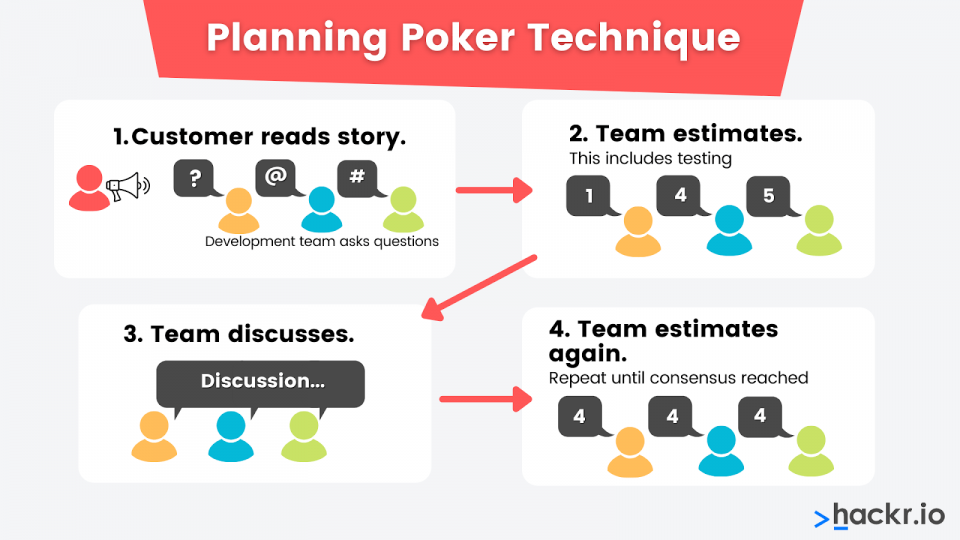
Planning Poker, also known as Scrum Poker, is a consensus-based tool that estimates the time and effort required to complete each task in the product backlog.
It helps the team identify issues in advance. It is mainly used to avoid too much external influence and encourages each member to think independently. This makes meetings more productive and creates estimates with respect to the whole team’s involvement.
31. What do you understand about the term “user story” in Agile?
A user story is the smallest work unit describing the software’s features from the user’s perspective. These stories are simple words describing the expected results. The user can later add new requirements to the user story.
32. What is Scrum, and what are its advantages?
Scrum is a lightweight process that encourages teamwork and manages product development to ensure the timely delivery of high-quality products. It helps manage the entire development process until all the customer’s requirements are met. Like in the general Agile process, the product is developed in the shortest period known as a sprint.
The following are some significant upsides of Scrum:
- Make quick releases and make them available to users and customers
- Ensures effective management of time and money to save cost
- Well suited for fast development projects
- Quickly adapt to rapid changes within the project
- Enhance creativity and innovation
- Divides complex projects into manageable sprints
33. What are the different roles in the scrum?
The following are the three different roles in the scrum:
- Scrum Master: A Scrum Master is the team’s supervisor, responsible for ensuring the team executes tasks efficiently
- Product Owner: A Product Owner is the project’s stakeholder, tasked with managing the product backlog and defining what to build for the team
- Development Team: The development team involves the entire team, who collectively work to deliver the final software product
34. What are the Scrum Master’s responsibilities?
The following are the responsibilities of the scrum master:
- Keeping their team motivated and focused on their tasks
- Guiding all team members so that they achieve the sprint goal efficiently
- Building an organized and motivated team
- Ensuring the team delivers as expected
- Ensuring adherence to all values, practices, and principles of Scrum
- Eliminating external obstacles for the team
- Resolving general issues
35. What is timeboxing in Scrum?
Timeboxing is a critical time management tool that limits the time spent to complete a specific task.
The maximum length of any timebox is 15 minutes, and you can change it as necessary. Timeboxing improves focus and increases productivity. Here are some timeboxed events in Scrum:
- Sprint
- Sprint Planning
- Daily Scrum
- Sprint Review
- Sprint retrospective
36. What do you know about impediments in Scrum?
Impediments are distractions that hinder the team’s progress. They reduce the team’s performance and productivity, which, in turn, reduces a project’s velocity.
The scrum master must try to eliminate the impediments to improve performance.
Some common impediments include:
- Resource crunches
- Unhealthy work environment
- Technical or operational issues
- Power or server outages
- Lack of Agile or Scrum knowledge
37. What are Some of the Principles of Agile Testing?
The key principles driving Agile testing are:
- Continuous testing
- Continuous feedback
- Involve the whole team
- Quick feedback
- High-quality software
- Less documentation
- Test driven
- Customer satisfaction
38. What are the Skills Required to be a Good Agile Tester?
A good Agile tester has the following skills:
- A thorough understanding of Agile and its principles
- Communication for client and team collaboration
- Analysis to understand requirements and prioritize tasks
- Adaptable as changes arise
39. What is a story point in Scrum?
In scrum, a story point is a unit that estimates the work required to complete a particular task.
40. What is Scrum of Scrums?
A scrum of scrums is a meeting of multiple scrum teams, each of which has one representative.
Bonus Tips to Prepare for your Agile Interview
There are some additional ways to prepare for an Agile interview. Consider:
- Practicing questions with a friend
- Reading original books on Agile and studying the Agile methodology
- Take courses on Agile development (more on that shortly).
It’s also worth reviewing your own development process and mulling over how you can deliver features faster.
Conclusion
The immense benefits of the Agile methodology is now widely accepted and has proven to be one of the best project management and software development approaches.
We hope that these Agile interview questions help you prepare for your interview. But don’t stop here! You have lots to learn about Agile, but these Agile methodology interview questions. questions serve as an excellent starting point.
Interested in expanding your knowledge?
People are also reading: