Let's discuss the best AI tools of 2025. This year we saw a burst of new artificial intelligence technologies. We even discussed how to build a chatbot with Python. So how do you maximize the impact of these tools on your life? Whether you use AI for development or as a creative professional, there are hundreds of new AI tools available.
Our evaluation focused on several factors. We considered the usefulness of each tool, ease of use, overall cost, and potential to change an industry. That means our list of the best AI tools includes AI image generators, chatbots, voice generators, and other useful products.
The Best AI Tools: Top Picks
After evaluating dozens of services, we came up with the following list of AI tools you need to know this year.
Our evaluations considered both the helpfulness of the service and the cost for the user. We considered both free AI tools and those with paid monthly subscription fees. Here are the results.
1. Karmatic.ai - Social Monitoring
- AI tool type: Brand Monitoring, Social Listening
- What it does: Surfaces relevant threads, keeps your brand top of mind
- Why we love it: Invaluable for SEO and AEO
- Price: Free and Paid Options
Why we chose this AI tool:
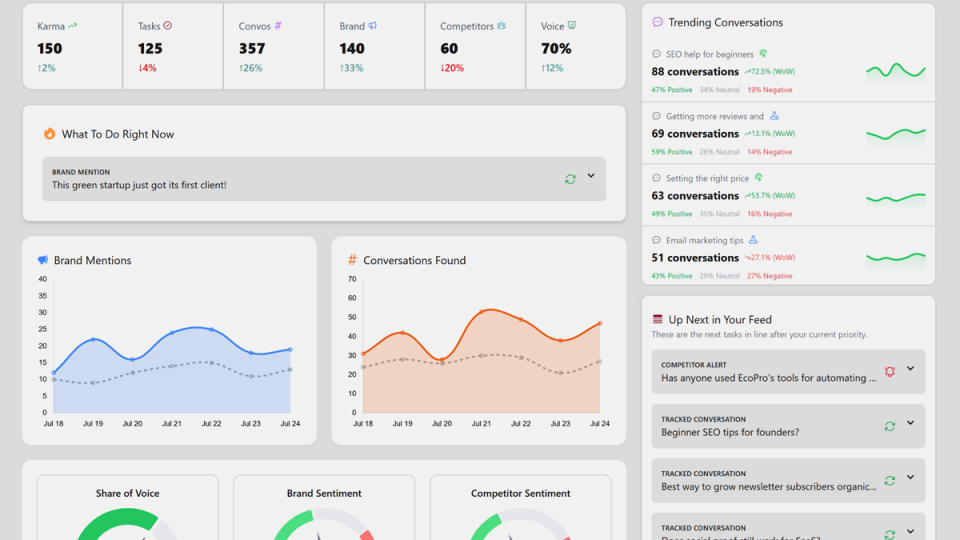
Karmatic does something we've never seen before. It combines social listening features with analysis and feedback, using machine learning to show brands exactly where they should be talking to their audiences. We've seen it work well for Reddit. It analyzes a brand, shows relevant conversations as they happen, and gives insightful analysis of what an audience is talking about.
That includes competitor analysis, brand sentiment, and guidance on what to post for an engaged conversation. It's truly unique. A major value for brands focused on growth.
One other major benefit? There's a free option that gives you access to brand alerts, which notifies you when your search term is mentioned. Paid plans include much more powerful features, including an activity feed that guides you where to meet your audience.
2. ChatGPT - Super-Popular Chatbot

- AI tool type: Chatbot
- What it does: Answers questions. Solves problems.
- Why we love it: ChatGPT offers an expansive, easy-to-use solution
- Price: Free (with paid options)
Why we chose this AI tool:
We evaluated dozens of AI tools, and ChatGPT earned top marks in every category. Not only did OpenAI create a free entry point for their new chatbot, but they also made an exceptional user interface and immediately delivered eye-wateringly amusing responses.
Data scientists should recognize the underlying infrastructure behind this popular AI tool. It’s a large language model (LLM) that uses natural language processing (NLP) to develop human-sounding responses to an unlimited number of topics.
Best of all, ChatGPT (and its little sister, Google Bard) uses machine learning to fine-tune results. That means these AI ML tools get smarter as more people use them. Consider what that means with a hugely popular launch. People asked this chatbot millions of questions and, with the ease of a conversation, trained it to give them more accurate responses.
Now like all tools, there are ways to interact with this AI tool like a professional. In general, this centers around prompt engineering to get the best responses. Plus, if you’re looking for something more specific, like ways to enhance your SEO, you can even use a ChatGPT cheat sheet designed for SEO.
3. Otter AI - Meeting Notes
- AI tool type: Meeting Assistant
- What it does: Listens in, gives you notes on your calls
- Why we love it: Time saver, helps us stay on task
- Price: Free and Paid Options
Why we chose this AI tool:
I was pretty dubious of Otter when it first rolled out, but now it summarizes almost all of my meetings. The result is a major timesaver. Just connect it to your meeting and it will listen in, tracking important topics and giving summaries after you hang up.
Main benefit? You don't have to have a dedicated notetaker on your call. Otter picks up the important parts, notes them down, and emails everyone who was on the call. It has a free version that gives you a bunch of value without having to fork over anything. And the paid versions are powerful enough to join multiple meetings at once.
4. Motion - Schedule Automation Tool

- AI tool type: Productivity
- What it does: Automates scheduling and to-do lists
- Why we love it: Can help save 14 hours of duplicated work each week
- Price: $19/month (billed annually) or $34/month (billed monthly) or view current pricing
Why we chose this AI tool:
Motion automates many of the tasks associated with scheduling. That's especially important at a desk job. With automated to-do lists (which prioritize your work) and a shared scheduling aspect, this AI tool ranks as one of our very highest for productivity.
It's also pretty neat to see how they justify the cost of the service. If Motion's AI tool saves you two hours per day, it asks what your time is worth. They also have a variety of integrations including Zoom, Google Calendar, Zapier, Gmail, and Outlook.
The other surprising aspect of this AI tool is the robust set of functions it provides. It works as a calendar, task manager, meeting assistant, and project management tool. Plus, it integrates with the most commonly used work resources. We found integrations for Google Calendar, Zoom, Zapier, Gmail, Outlook, and more.
5. Midjourney - AI Image Creation

- AI tool type: Image Generator
- What it does: Generates images in countless styles
- Why we love it: Free option creates stunning art
- Price: Free plan with paid options from $10 (Check for current pricing)
In what should come as no surprise to anyone who used artificial intelligence to create images this year, our evaluation ranks Midjourney as the best at its specific function.
For better or worse, this popular AI tool requires Discord to function. Input your prompt, wait a minute, and the generator produces surprising and impressive results. Users have already embraced Midjourney’s prompt submissions as a form of art.
We’re eager to see what else comes from this AI tool. With generous commercial terms and an expansive free trial version, we expect to see much more news from Midjourney throughout the year.
If you're looking for a direct competitor, check out Stable Diffusion. It's another AI image-generation tool, and it's exceptionally popular with those looking for photorealism or working with complex image prompts.
6. Murf - AI Voice Generator

- AI tool type: AI Voice Generator
- What it does: Converts text to speech
- Why we love it: Generates voices in up to 20 languages
- Price: From $29/month or $228/year (Check current pricing)
Why we chose this AI tool:
Murf.ai improves on traditional text-to-speech technology with AI-generated voices in up to 20 languages. The service includes soundtracks and royalty-free music with its paid plans, and users can also use the service for transcription.
As with our other top AI tools, we loved the ability to enhance our results with quick edits. Murf enables the addition of images, video, and music in addition to voice modifications on pitch, style, speed, and emphasis.
Our evaluation revealed value for podcasters, video producers, social media managers, and others who need to quickly create high volumes of content. Limitations on the free trial reduce overall access for many potential users.
Interested in learning how to create this type of artificial intelligence? We’ve also ranked the best NLP courses based on contributions from the community at Hackr.io.
7. Adobe Premiere Pro - Professional Video Editor

- AI tool type: Video Editor
- What it does: Leverages AI-powered video editing
- Why we love it: Industry-standard brand with bleeding-edge technology
- Price: From $20.99/month or (Check current pricing)
Why we chose this AI tool:
Professional video editors trust Adobe as an industry-standard product. We use it at work, and we use it at home. But those aren’t the reasons we love it for our list of popular AI tools. We chose to include it here for its powerful built-in artificial intelligence features.
Here are the specifics: Adobe rolled out color matching, morph cutting, automatic reframing, and automatic scene detection. These AI tools allow video editors to save time with many steps of the video production process.
Automatic scene detection, for example, uses artificial intelligence to guide its cut choices. That means editors only have to choose whether to keep or omit cuts already made by the software.
As an industry leader, Adobe absolutely nailed this implementation. It earned a spot on our top choices for AI tools this year.
8. Fireflies - Meeting and Voice Analyzer

- AI tool type: AI Transcription
- What it does: Transcribes meeting notes
- Why we love it: Automates meeting recordings, transcriptions, and notes
- Price: Free with paid options from $10 per seat/month (Check current pricing)
Why we chose this AI tool:
We love AI tools that provide value to everyone on the team. Many of the services and software we evaluated only benefit a single person at a time. That’s where Fireflies differentiates itself.
This AI meeting analyzer records meetings, transcribes them, and makes them searchable for weeks, months, or years down the road.
That means you don’t need to delegate a single member of your team to update your Google Docs. Fireflies does that heavy lifting automatically. And the built-in transcription feature relies on artificial intelligence to process and analyze language.
Best yet, it integrates with Zoom, Google Meets, and other popular webcam software. The team doesn’t have to change where they already meet. With free and paid options, our evaluation ranked this as one of the top AI tools of the year.
9. DALL-E 2 - AI Image Generator

- AI tool type: Image Generator
- What it does: Generates images
- Why we love it: Made by the genius team at OpenAI
- Price: 115 Credits for $15 (Pricing info in the OpenAI help section)
Why we chose this AI tool:
Created by the genius team at OpenAI, Dall-E 2 works in a very similar way to Midjourney. It uses natural language processing and understanding to translate text prompts into images. Plus, it doesn’t require Discord.
We included DALL-E 2 on our list because, after evaluation, it still ranks as a viable competitor in the space. That said, the pricing model reduces its ranking below that of its peer. While there used to be a valuable free option, that’s no longer the case for new subscribers.
If you have the extra money to spend, it could be worth checking out DALL-E 2. Just make sure to try its competitor first.
10. Tome - AI Storytelling Partner

- AI tool type: Presentation Builder
- What it does: Create text, images, and slides for presentations
- Why we love it: Few tools offer such a robust service at such a low price
- Price: Free with paid options from $8/month (Check current pricing)
Why we chose this AI tool:
We evaluated Tome expecting it to function like an AI writing service. Instead, it used a single prompt to generate a six-slide presentation, including images and multiple paragraphs of text, within seconds.
Given the exceptionally-low price point, that’s an almost unparalleled value among the other AI tools we tested. We expect Tome to offer the best value to those who need to quickly create personalized presentations on a regular basis, and there are a few other communities who could benefit as well.
Tome also allows users to add their own images, edit presentations with a drag-and-drop web editor, and record narration. That means it should be a powerful AI tool for teachers, content creators, and small marketing teams.
11. Lumen5 - AI-Powered Video Creation

- AI tool type: Online Video Creator
- What it does: Quickly makes videos
- Why we love it: Simple online interface and works quickly
- Price: From $29/month (Check for current pricing)
Why we chose this AI tool:
We compared Lumen5 to Tome, which both offer online drag-and-drop editors to create presentations. The difference here is that one of them specializes in video. That’s Lumen5. It doesn’t take much effort to create a video quickly with this AI tool.
Unfortunately, it comes at a higher price than the presentation builder we mentioned earlier. Our favorite AI tools offer robust free tiers of service. Those help customers acclimate to the software and give the service a better chance of becoming an industry-standard in future years.
Because of the relatively low monthly fee, large stock library, and ability to add watermarks (for top-tier users), Lumen5 ranks well for business users. Those with a content budget can certainly save time with this popular AI tool.
12. GitHub Copilot - AI Coding Partner

- AI tool type: AI Coder
- What it does: Helps you code
- Why we love it: If you’ve ever used GitHub for coding, you’ll already understand.
- Price: From $10/month (Check for current pricing)
Why we chose this AI tool:
We’ve discussed how many coders rely on ChatGPT for assistance with coding. That’s what makes GitHub Copilot such a valuable resource. It’s built with the OpenAI Codex. Coders don’t need much experience to get massive results.
Imagine typing a prompt and having GitHub offer the exact code you need to solve your problem. That’s the benefit of this AI tool for programmers. Just write a comment with your needs, and Copilot writes a potential solution.
Given the usefulness of this AI tool, its variety of applications, and its low monthly cost, the only reason it doesn’t rank higher is the lack of a free tier for those without the means to spend $10 a month. But unlike other AI-powered chatbots, Copilot was built especially for coding.
13. NeuralText - AI Writing Assistant

- AI tool type: NLP Writing Assistant
- What it does: Improves content
- Why we love it: Cheaper than other AI SEO tools
- Price: From $19/month (Check current pricing)
Why we chose this AI tool:
Volume is the name of the game for many content production companies. That makes AI writing tools like NeuralText, a natural partner.
Using natural language processing, natural language understanding, and contextual data, these types of services save enormous amounts of time for low-paid content writers and overworked SEO managers. Popular AI tools for SEO also include Jasper and SE Ranking.
That said, we evaluated many so-called “writing assistants” for our list of the best AI tools of the year. There’s a caveat for their inclusion. Many of these services focus on improving SEO, and most of them are now overshadowed by ChatGPT.
Consider the restrictions on NeuralText’s packages. At the time of our evaluation, the Basic package limited users to only 20,000 AI-generated words per month. That was limited further by a maximum of 40 article optimizations. Can you guess which free service doesn’t limit how many articles you can optimize? That’s right. It’s our number one pick, ChatGPT.
Note that you can also use the AI tools at Grammarly for some help with writing. That service sometimes goes on sale for $85/year and does a fine job of checking grammar. This is especially helpful for anyone writing blog posts, social media posts, or repetitive product descriptions.
Top AI Tools: Our Honorable Mentions
Not every popular AI tool could make our top-ten list. That’s why we wanted to mention a few other noteworthy pieces of software and services. Our research showed these AI tools still have value. And remember, there are different functions for different industries (including many just for use as a consumer).
While we checked out the following organizers, planners, animaters, and other projects, some lost out to powerful chatbots on both cost and value.
BeforeSunset - Calendar, Task, & To-Do Organization
Main feature: AI-powered task organization for optimized workflows
 Our Considerations:
BeforeSunset is an AI-powered web application that helps plan and sync your to-do list with your calendar. You only need to create actionable tasks or subtasks to let the AI engine figure out the optimal way to organize them and fit them into your day.
You can even use a time-tracking feature to retroactively analyze how long you’ve spent on tasks. This is a great way to figure out whether you’re an over or underestimator. We also like that they provide an analytics console to help you determine where you spend your time based on task tags.
Whether you need help organizing your personal or professional to-do list, having an AI assistant do the heavy lifting can help you spend your time doing rather than planning.
Use Cases:
- To-do list and task organization
- Calendar optimization
- Analysis of time spend
LALAL - High-Quality Stem Splitting

Main feature: AI-powered platform for high-quality stem splitting
Our Considerations:
LALAL is an AI-powered platform for separating vocals and instruments from any audio and video. LALAL is useful because it provides an easy and accessible way for anyone to separate vocals and instruments from music tracks, allowing them to create new remixes, covers, or other types of audio content.
Its AI-powered technology delivers high-quality audio output files that can be used for professional purposes, saving time and effort for music producers, DJs, podcast producers, and other professionals alike. Some key features include AI algorithms for vocal and instrumental separation, high-quality audio output, an easy-to-use interface, and batch processing of files.
Use Cases:
- Music production
- Podcasts and voiceovers
- Audio restoration
Jitter - Animated Content Made Simple

Main feature: Jitter enables teams to create and edit animated content with ease.
Our Considerations:
Jitter uses advanced AI technology to automate the video creation process, making it easy and accessible for anyone to create high-quality videos. Jitter is useful because it allows anyone to create high-quality videos without the need for expensive equipment or extensive technical knowledge.
Its AI-powered technology streamlines the animated content creation process and makes it possible for users to quickly and easily produce engaging content for a variety of purposes. Some key features include AI-powered video creation, easy editing tools, and collaboration/sharing capabilities.
Use Cases:
- Social media content creation
- Marketing and advertisements
- Personal video content creation
- Education and training videos
TLDR this - Automatic Summarizer

Main feature: AI-powered summarizing and paraphrasing tool
Our Considerations:
TLDR is an AI-powered platform that allows you to summarize articles and web pages with just one click. It is useful for anyone who wants to stay informed but doesn’t have the time to read lengthy articles or who wants to get a quick overview of a topic before diving into a more detailed exploration.
Key features of the platform include a browser extension, the ability to customize the length and level of detail of the summary, allowing for metadata extraction, and eliminating any ads or graphics from the summary allowing for a distraction-free experience.
Those looking for summaries of meetings may also want to check out Otter. It's becoming a standard for many businesses who want to get meeting transcripts, summaries, and actionable insights.
Use Cases:
- For students who are studying and need to summarize information
- Teachers who want to summarize large texts for their students
- Journalists and writers that need to summarize long articles
- Anyone who needs to gain a summarized level of understanding of a long article
WALLET.AI - Financial Behavior Analyzer

Main feature: AI-powered tool that informs you on your financial behavior
Our Considerations:
WALLET.AI is an AI-powered tool that can analyze your data and provide you with information about your financial habits. WALLET.AI is useful because it enables you to make wiser financial decisions.
To make sure that WALLET.AI’s engine is intelligent enough to understand your financial data and assist you in making smarter financial decisions, it was trained on vast volumes of financial data.
Note that we did a much deeper review of another AI financial advisor. Read our review of CLEO (which has a sassy personality that either roasts or praises your financial choices).
Use Cases:
- Analyze your financial data
- Make data-driven financial decisions
SUPER MEME - Text to Meme Platform

Main feature: Text to Meme platform powered by AI
Our Considerations:
SUPER MEME is an AI-powered text-to-meme platform that allows you to generate memes from text in natural language. The memes are 100% generated by AI, which also writes the appropriate captions based on the topic in the input text.
The meme-to-text platform also comes with over 1000 high-quality meme templates that are completely safe for work. SUPER MEME may benefit some social media teams, small marketing teams, or bored professionals.
Use Cases:
- Create content for marketing and ads
- Generate content for social media
- Educators can create fun and engaging content for students
Gemini - Chatbot

Main feature: Chatbot
Our Considerations:
Google's Gemini is 100% better now than when it was released, but it's still prone to many hallucinations. Unfortunately, it's also something that rolled out on search result pages.
Now, the content you ask for from trusted sites is distilled by AI, run through an LLM, and spat back out (often with errors) above the trustworthy sites you want to visit. Gemini is still a powerful tool, very similar to ChatGPT, and it connects with the Google Suite of products. That means you can use it with Google Docs or Gmail, which can be a major time saver.
If it weren't for the major faults in the search engine experience (which has caused plenty of issues for independent publishers), this AI tool would have ranked much higher on the list. Google, however, continues to add functionality to this service. Be on the lookout for game-changing AI video generation in the future.
Use Cases:
- Review long documents with short distilled synopses
- Many free options for chatbot and quick answers to questions
- Chat with Gemini for ideas and to organize thoughts
- Use it as a coding assistant
Descript - Video and Audio Editor

Main feature: Video editing
Our Considerations:
I first encountered Descript as a podcast editor. It automatically transcribes audio and video. Now, that service keeps improving. The video editor has intuitive controls and, with the click of a button, can create social-media ready clips and synopses.
Descript is one of the most powerful tools I've used for video (and audio) editing. Plus there's a free version that gives you the full experience. Unlike many other tools on this list, this one has not ai chatbot functions. It's much more of a video editor than a customer service bot.
Use Cases:
- Edit videos for YouTube or social media
- Edit podcast episodes (with or without video)
- One-click option to fix audio issues with "studio sound"
- Multiple export options for GIF, MPEG, and audio files
So, What is AI?
The community at Hackr.io regularly submits AI courses and tutorials. So when we talk about artificial intelligence, what do we mean? The short answer is simple: AI encompasses theories and practices that use machines to replicate human decision-making.
That includes learning, reasoning, problem-solving, and decision-making. If that sounds familiar, you’ve been paying attention to the news. Chatbots like ChatGPT and Google Bard recently made waves across the working world for their ability to communicate almost as well as a human.
This isn’t a new field of study. Artificial intelligence earned headlines in the 1950s when Christopher Strachey designed a checkers-playing program. Since then, the field has exploded in popularity.
Today, we use AI tools for various tasks, from speech recognition and image processing to autonomous driving and medical diagnosis. In simple terms, AI is a way to make machines "smart" and capable of doing things that normally require human intelligence.
The explosion of AI can be seen in the proliferation of AI-powered products and services, such as virtual assistants, self-driving cars, personalized recommendation systems, and predictive analytics. AI is also transforming industries, such as healthcare, finance, and manufacturing, by improving efficiency, accuracy, and decision-making.
Did you find this information useful? Note that we also covered the best SEO tools.
What are AI Tools?
We use the term “AI tools” for software applications or platforms that utilize artificial intelligence techniques to perform specific tasks, automate processes, or augment human decision-making.
AI tools can range from simple chatbots to complex machine-learning algorithms and can be used for various purposes.
The number of AI tools available is growing rapidly, with new tools being developed and released all the time. These are designed to make AI accessible to businesses of all sizes, from startups to large enterprises. They can also help companies streamline their operations, reduce costs, and improve their bottom line.
If you’re a manager or business leader that wants to integrate AI into your business, we’d highly recommend Oxford University’s AI program and downloading their prospectus. This is purposely designed to help non-technical professionals harness AI for business growth.
Types of AI Tools
There are several common uses for AI tools. Let's talk about some of the best time-saving uses.
AI Presentation Generator
Presentation generators are some of the most popular AI tools of the year. So, what do they do? You can use AI presentation generators to replace your current slide-building process in Google Slides or PowerPoint. Different tools have different benefits, but most offer help with content writing, automating layouts, and improved structuring.
That means you don't have to spend hours putting together a sales presentation. Just plug into something like Tome or beautiful.ai to make something in minutes.
AI Coding Partners
Another commonly-used AI tool is a coding partner. These systems do the coding for you. You just need to know how to ask for help. If you're already a talented coder, an AI coding partner saves hundreds or thousands of hours of repetitive work.
There's a reason everyone to be using these. We've seen many AI tools for developers, but the leading choices (aside from Bard or GPT) remains GitHub's Copilot.
AI Productivity Tools
We rely on tools like Motion to save time with everyday tasks. Some help with our own scheduling and to-do lists, but they also function as part of the daily workflow on the job. We evaluated AI tools for home and business uses, and productivity tools seem to have the most overlap in those two worlds.
Try Motion for help with your to-do lists, or use it for much larger and more complex tasks. It even works as an AI project management tool.
Final Thoughts
Our team evaluated the most popular AI tools available in 2024. We considered several facets while conducting our research, including the cost of the service, how the AI tools responded to queries, and whether we saw industrial value lasting more than a year. Our community discusses AI tutorials regularly. We looked for the tools that we already use, and we also considered new AI tools that had just launched in the past few weeks and months. The results were clear.
Chatbots outweigh most other popular AI tools for regular usage throughout the workday. That doesn’t make them the best, and not all chatbots are created equal. To help save you time, we listed the best AI tools in 2024 with respect to their performance and their value.
While we’ve all seen tech trends come and go each year (anyone remember Bored Apes?), this year, the conversation centers on the applications of AI. But unlike Tiger King, NFTs, and the Metaverse, this trend seems different. Artificial intelligence tools have the power to impact every industry in the modern world, whether that’s developers turning to ChatGPT or creative professionals harnessing the best AI image generators.
Has all this talk of tools for AI encouraged you to build one? Check out:
The Best AI Projects with Source Code
Frequently Asked Questions
1. Which Type of AI Is Mostly Used?
This is a difficult question, as AI tools appear in almost every industry today. Consider how self-driving cars use artificial intelligence to avoid obstacles, how friendly chatbots rely on natural language processing to respond to queries, and how modern surveillance cameras can detect and report license plates on stolen vehicles.
2. What Is the Most Powerful AI?
Determining the most powerful AI would require a single metric of power across a variety of uses. This is not currently possible, so we cannot say there’s a single most powerful artificial intelligence. Maybe once we reach the singularity, our new overlords will decide for us!
3. What Is Machine Learning?
Data scientists use machine learning to help computers understand how to evaluate their successes and failures. Once they have a working model, they can “learn” from it to make guesses more accurate. That’s the basis of machine learning.
4. Which AI Tools Can I Use for Video?
We found several popular AI tools for video editing. Consider Adobe Premiere Pro, for example. While this popular video editing software wasn’t built as an artificial intelligence platform, it now provides built-in AI tools for video editing.
People are also reading:
- Top Artificial Intelligence Technologies
- Different Types of AI [Artificial Intelligence]
- Best Artificial Intelligence Books for Beginners
- Benefits of Artificial Intelligence
- Best Programming Language for AI Development
- Best AI Projects With Source Code
- How to learn Artificial Intelligence
- Best Artificial Intelligence Courses
